

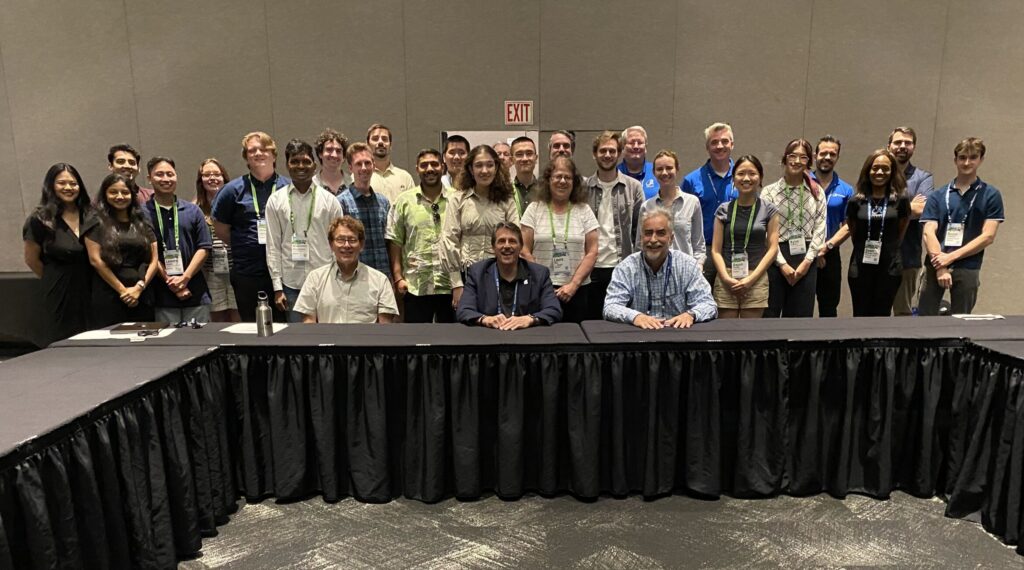
For researchers developing the next generation of small spacecraft technologies, understanding how those innovations could be used beyond the lab is an important part of the process. Through NASA I-Corps, a group of researchers spent the month of August exploring that question, culminating in conversations with industry experts and potential customers at the Small Satellite Conference in Salt Lake City, Utah.
The trip followed a NASA I-Corps course led by the NSF Interior Northeast I-Corps Hub, where participants spent several weeks learning and applying customer discovery, a process designed to help researchers better understand the people and organizations who may ultimately use their technology.
For the cohort, the conference was about getting out of the lab and connecting with the people who understand the small spacecraft ecosystem firsthand. The teams put their training into practice, speaking directly with potential customers, industry professionals, NASA experts, and other stakeholders to test their assumptions and better understand the problems their technologies could solve.
“The I-Corps program gave us the structure and vehicle to investigate some of the open application questions for the technology, which has allowed us to target technology development in the most critical customer value-producing aspects,” said Stefan Bell, founder of Sagitta Borealis Systems.
Teams also participated in specialized NASA-led sessions at the conference, including an I-Corps Fireside Chat featuring perspectives from NASA, Advanced Space, and the broader space innovation community, as well as a session on how companies and researchers can engage with NASA.
Participant Phillip Ridley said, “Coming from academic battery research, my team [Dyad Orbital] learned how the small sat industry approaches system design and the challenges that are unique to deploying energy storage in space.”
The Small Sat conference convened 5,550 attendees, 450 exhibiting companies, and over 1,800 organizations representing various sectors, making it the perfect setting for I-Corps participants to find potential customers and industry stakeholders to interview.
Eleven teams completed the course:
- ALPHA-DT (Engin Taze, University of New Hampshire) is developing a physics-based digital twin that combines sensor data and mathematical models to estimate what is happening inside aircraft, spacecraft, and other aerospace systems even when those conditions cannot be directly measured. The technology could help operators monitor spacecraft health, identify problems earlier, and reduce the need for extensive physical testing.
- Dyad Orbital (Phillip Ridley and Maebh O’Neill – CUNY City College) is developing a hybrid battery system that combines high-power and high-energy battery chemistries in a single spacecraft power system. An AI-based energy management system would determine how to distribute power between the two, with the goal of extending battery life while reducing mass and improving performance.
- Ephemeris (Anirvan Bordoloi, Lianne “Celeste” Bisch, and Rishika Juloori – Cornell University) is developing a decision-support platform for satellite collision avoidance. The technology uses orbital data and machine learning to identify which of the many potential collision alerts facing satellite operators are most likely to become serious, helping operators focus their attention on the risks that actually require action.
- NavSieve (Dayun Hwang – Cornell University) is developing an autonomous navigation-confidence system for spacecraft operating where GPS and other traditional navigation resources may be unavailable or unreliable. By combining navigation data with information about environmental conditions and spacecraft health, the technology could help small spacecraft determine when to trust their sensors, recalibrate, conserve power, or adjust operations.
- Rugged MicroPower (Paul Shepherd) is developing compact, radiation-hardened power electronics designed to operate at much higher voltages and power levels than current integrated space-rated modules. The technology aims to make high-power spacecraft systems smaller and more efficient while withstanding the extreme conditions of space.
- Sagitta Borealis Systems Inc. (Stefan Bell and Carl Geiger – Cornell University) is developing an additively manufactured electrospray propulsion system that uses a nanoparticle-based ionic propellant. The compact thruster is designed to provide highly efficient propulsion for small spacecraft, potentially enabling more capable and maneuverable missions without requiring large propulsion systems.
- Spacelenz (Nicholas Behrens and Noor Dewood – Cornell University) is developing a compact optical component called a multi-color spaceplate that can dramatically shorten the physical length of an imaging system while maintaining image quality. The technology could enable thinner, lighter optical systems for satellites, drones, medical imaging, and extended-reality devices.
- Space Mobility Research Group (Oliver Jia-Richards – University of Michigan) is developing software that allows spacecraft to autonomously respond to system failures, particularly failures in the actuators responsible for controlling a satellite’s movement. Using reinforcement learning, the system can adapt its behavior when conditions change, reducing the need for continuous human intervention.
- SpaceRAPTOR (Sivaperuman Muniyasamy and Steven Wood – University of Arizona) is developing an efficient onboard perception system that allows spacecraft to identify and understand nearby objects using imagery. The technology is designed to support applications such as spacecraft inspection, rendezvous, docking, servicing, and autonomous navigation without relying on visual markers placed on the target spacecraft.
- Space Systems Design Studio (Arthur Chadwick and Mark Lohatepanont – Cornell University) is developing small “Booster Pack” spacecraft that can dock with existing satellites and provide additional propulsion for orbit raising, station keeping, and controlled deorbiting. The approach could extend the useful life of spacecraft that would otherwise become unusable because they can no longer maintain their required orbit.
- UNLV ATLAS-1 (Kylee Brahma, Christian Lugowski, and Leandro Araiza – University of Nevada, Las Vegas) is developing a low-cost, open-source pathway for teams with limited aerospace experience to progress from basic spacecraft hardware to an orbital mission. The project is using an undergraduate-led CubeSat as a proof of concept, with a mission to collect thermal and radiation data in orbit and compare the results with existing simulation models.
“We learned that there were more opportunities for solving customers’ problems than our initial thoughts,” Bell said. “The course did not fundamentally change our value proposition. However, the course did allow us to focus on who to target in future marketing and what pain points to target in our technology development going forward.”
The experience reflects a central goal of NASA I-Corps: helping researchers move beyond the demonstration of functional technology to understanding where it can create meaningful value. For emerging space technologies, that distinction can be critical. A technically successful innovation still needs a clear customer, a compelling use case, and a path toward adoption.
The Small Satellite Conference provided this year’s cohort with a unique environment to begin answering those questions while connecting researchers with the broader community working to shape the future of small spacecraft.