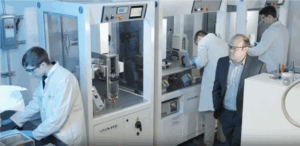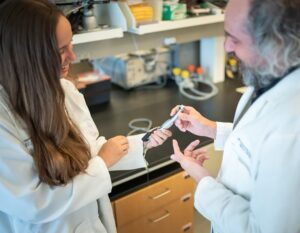
Pittsburgh-based Surface Design Solutions has raised $925,000 and hired four employees to help manufacturers achieve dramatic cost reductions by optimizing surfaces.
read moreAneurisk, a Pittsburgh-based medical software startup, has hired eight employees and raised over $1 million to develop AI-enabled tools to improve the diagnosis and management of abdominal aortic aneurysms (AAA).
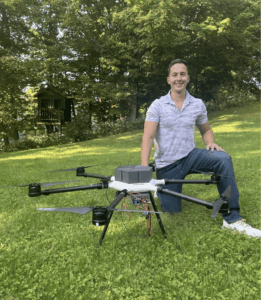
read moreBinghamton University’s team of Assistant Professor Jayson Boubin and Ph.D. student Melika Dastranj developed REMIX, a drone-mounted hyperspectral camera system capable of processing massive amounts of data in real time to detect early signs of crop disease.
read moreSodium-ion battery solution company Standard Potential conducted in-person customer discovery interviews at The Battery Show through a 2023 I-Corps course.
read moreA $1.25 million grant will help I-Corps alumni startup Photonect Interconnect Solutions advance the commercialization of its photonics innovation. Photonics technology can make data centers and telecommunications networks, which require a lot of power to handle internet traffic and cloud storage, more cost- and energy-efficient.
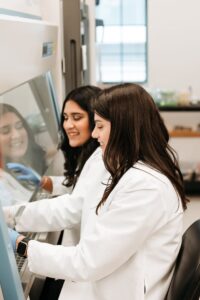
read moreThis June, an I-Corps cohort of oncology researchers – each working on a cutting-edge solution to improve care and outcomes for cancer patients – took to Chicago for the American Society for Clinical Oncology (ASCO) Annual Meeting to interview clinicians about their biggest problems.
read moreThis February, Cornell health technology startup SensVita, which has developed a touch-free way of monitoring of heart and lung functions, was awarded a $305,000 STTR Phase I grant from the National Science Foundation.
read moreI-Corps alumni startup AreaHub has taken a major step in their mission to inform businesses and individuals with environmental risk intelligence.
read moreIn September, the National Institutes of Health’s National Institute of Neurological Disorders and Stroke (NINDS) awarded Neuralenz a $500k Phase I STTR grant for developing a new, non-invasive measurement of cerebral blood flow that could enable doctors to rapidly detect neurological damage and treat it more accurately.
read moreEchoICs, an I-Corps regional course alum and 2022 National I-Corps Team participant, received a $275,000 STTR Phase I Award from the National Science Foundation in August. Founded by Dr. Alyssa Apsel, Director of Computer Engineering at Cornell University, and postdoctoral student Thomas Tapen, EchoICs developed a new flexible spectrum radio for more efficient military communications and commercial cellular usage.
read more