

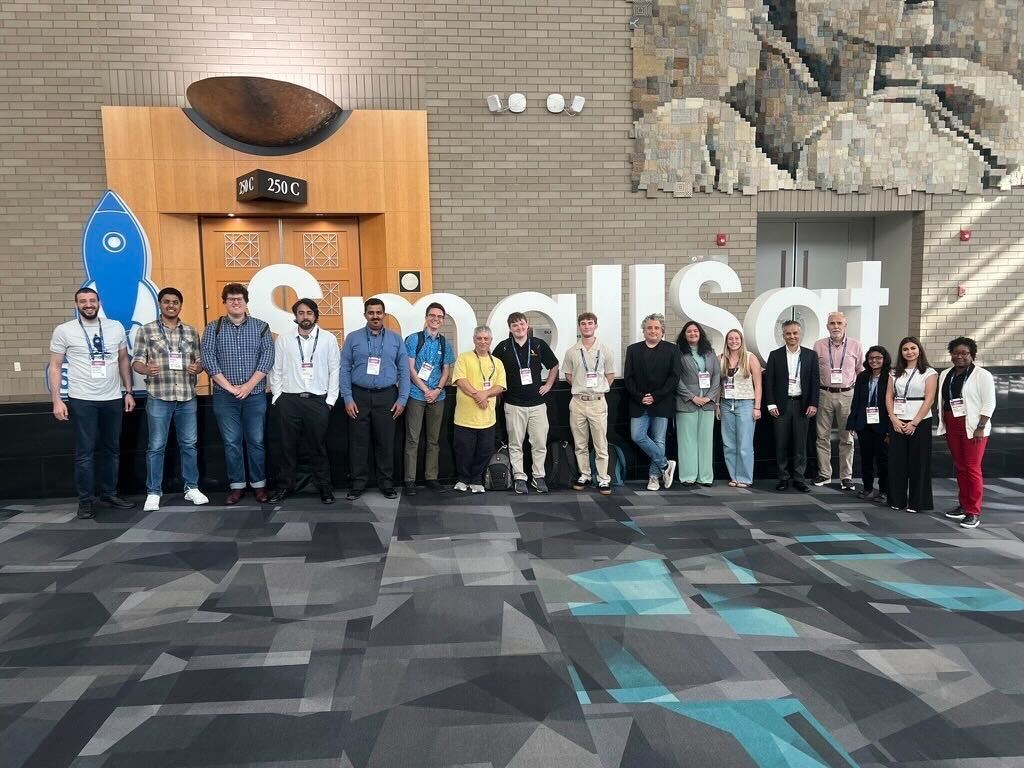
In August 2025, a group of researchers developing small spacecraft innovations explored the potential real-world impact of their technology at the Small Satellites conference in Salt Lake City, UT. The trip was the culmination of a specialized NSF I-Corps regional course led by the Interior Northeast I-Corps Hub (IN I-Corps) in collaboration with NASA.
In preparation for the conference, teams underwent two weeks of virtual training on customer discovery, a methodology to evaluate the potential to advance new technologies from the lab into the marketplace. They deployed their new skills at the conference, interviewing at least 30 potential customers to gain a better understanding of pain points their solution could address.
“I learned that the market for my opportunity was different than I had expected, but I was able to identify new market opportunities and really hone in on who would be interested in my product, and why,” said Michael Zemcov, associate professor in the School of Physics and Astronomy at the Rochester Institute of Technology. “The course both broadened my thinking, in that I was able to identify new potential market segments, and sharpened it, in that it became much clearer who specifically to reach out to and what questions to ask them to improve my value proposition.”
The NASA I-Corps Pilot reflects the agency’s focus on developing autonomy, edge computation, and interoperable networking technologies for small spacecraft. Innovation in these areas will allow for expanded space capabilities at lower costs and with shorter development timelines, impacting sectors like defense, agriculture, telecommunications, and more.
The Small Sat conference convened 4,650 attendees, 374 exhibiting companies, and 1,300 organizations representing those sectors, making it the perfect setting for I-Corps participants to find potential customers and industry stakeholders to interview.
Nine teams completed the course:
- AlloAI (Biswas Rijal – University at Buffalo) is commercializing a novel alloy that is both lightweight and capable of withstanding high temperatures, as well as the AI-accelerated platform used to design it. The innovation could enable more efficient engines, longer-lasting spacecraft components, and stronger, more agile defense systems.
- BetahWorx (Marlene Hackett – IEEE) is developing a cybersecurity solution that uses sensor data to generate encryption keys for unmanned systems, rather than relying on stored encryption keys.
- CarbonEdge Energy (Abdullah AlShuaibi – Cornell University) is developing a lithium carbon dioxide battery platform with high cyclability, low overpotential, and high capacity, making it well-suited for applications in small spacecraft.
- Luminescence (Dominic Fucile, Paul Fucile, and Bryce Mahan – Woods Hole Oceanographic Institution) is developing local optical and thermal calibrators for imaging instruments aboard small spacecraft, a low-cost system that would equip small satellites with technological capabilities usually reserved for larger vehicles.
- Microwave Neural Networks (Bal Govind – Cornell University) is developing a microchip that processes high-speed digital signals, radar, and other wireless signals while consuming less than 200 milliwatts of power. The chip could be deployed in any industry that requires high-performance computing with fewer power and bandwidth constraints, including space technology.
- NexPhase (Ahmed Alajlouni and Amey Jitendra Shinde – Binghamton University) is developing a continuous casting process to manufacture high-performance, durable micro- and nano-encapsulated phase change materials for thermal management applications.
- Panoptes Orbital Innovations (Michael Zemcov – Rochester Institute of Technology) is developing a technology to detect and tag artificial satellites in astronomical data that could be used for target identification.
- REMIX (Jayson Boubin and Melika Dastranj – Binghamton University) is leveraging a custom software library, light-weight hyperspectral camera, and small embedded device to process and visualize hyperspectral imaging (HSI) data in real-time. The technology could serve as a less expensive alternative to satellites for HIS detection.
- Sensory Vision (Brittany Gomez and Navodita Mathur – University of Pittsburgh) is integrating a lightweight machine learning model with hyperspectral imaging to detect features invisible to standard RGB, without the need for massive training datasets and cloud connectivity on small spacecraft.
“Our interviews helped us refine where our technology adds value,” said Ahmed Alajlouni, a Ph.D. candidate in mechanical engineering at Binghamton University. “The course pushed us to pivot from a performance-only message to a clearer value proposition: glass-encapsulated phase change materials that first reduce system volume and complexity, then improve reliability, and finally lower costs.”
Cornell University’s Ken Rother, an Entrepreneur in Residence, and Hunter Adams, lecturer in the School of Electrical and Computer Engineering, instructed the course. While earning his Ph.D. in aerospace engineering at Cornell, Adams developed small satellites for agriculture applications and evaluated the technology’s product-market fit through I-Corps regional and national programs.
During the trip, Rother and Adams provided in-person entrepreneurship coaching to guide teams as they conducted interviews. Afterward, the cohort reconvened for a final virtual session to discuss what they learned from the experience and their future plans. Participants also received information about the NSF’s I-Corps Teams national program, which awards up to $50,000 to conduct 100 or more customer discovery interviews.